
0034 686009408
info@villasolrealestate.com

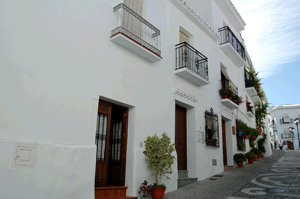
Frigiliana is only 7 kilometers drive inland from Nerja and is one of Andalucia's famous "White Villages".
It was lights, camera, action in Frigiliana as the town became the location for a new movie. The years were rolled back as the film, called Follow Your Sunshine, is set in the 1950s. Due to be released in September 2015, the movie is the first part of trilogy, The Lovaganza Convoy. French directors Genevieve and Gagnon brought a team of 50 people to the town and 25 extras were chosen from among 500 local candidates who attended the casting session.
In addition, the historical centre was closed to traffic as the film brought a touch of nostalgia to the town. It evoked memories of by- gone times as actors in period costume strolled through the traffic-free streets.The impact of the production has been very beneficial to the town, according to Head of Tourism, Maria Jose Caravaca. We are aware of the uniqueness of our town, and our mission is to promote its attractions during the whole year. To be chosen as the set for such an important production is a big boost for the town, said Caravaca.
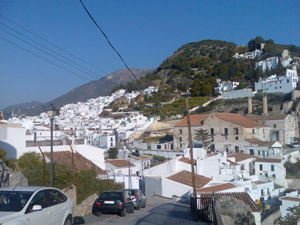
If you are thinking of buying or renting a property away from the hustle of the coast, Frigiliana might just be be the choice for you. We have a selection of apartments for sale in Frigiliana as well as Villas and town houses and a choice of long term rentals in Frigiliana as well.
On the drive to Frigiliana from Nerja the town just appears on the hillside in front of you as you turn a bend in the road and while there has been substantial development over the past few years it still retains a lot of it's original character with windy and sometimes hilly narrow pretty streets with flowers and plants spilling over from small terraces and window boxes.
Originally a town with a history of Moors, Christians and Jews, Frigiliana is famous for it's local honey and wines. In August every year Frigiliana hosts it's famous 3 cultures festival to celebrate this part of it's history with a food and craft fair and live music and entertainment.
Street Market of Frigiliana (Mercadillo de Frigiliana)in thePlaza de las Tres Culturas: Thursday (8:00 to 14:00) There are 40 stalls.
Malaga, Torrox, Nerja and Torre del Mar are all within a day visit distance by car. The beautiful Almijara Natural Park is perfect for outdoor lovers, who can enjoy rambling, hiking, mountain biking and bird watching, amongst others.
There are many excellent restaurants offering good value and excellent cuisine in Frigiliana, in the main plaza (square) there are some lovely places to eat and if you explore a little further you will find little restaurants tucked away in the villages cobbled streets. Head up to the Mirador (viewing point) at the top of the village, here you can enjoy a bite to eat and wonderful views.
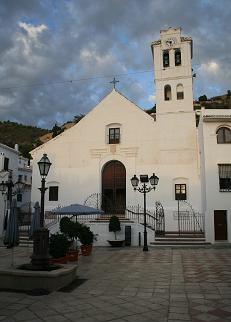
The Church of San Antonio de Padua is located at Calle Real, 100. This church was built in 1696 by Bernardo de Godoi. The style is Renaissance and the ground plan is the Latin cross, divided into three naves. There is a cupola that is hemispherical shape. The choir is decorated in the Rococo style, created by Bartolome de la Cruz in 1859. The main altar has a retable in the Baroque style and is dedicated to the Sacred Heart. This contains three paintings from the School of Sevilla from the 17th century, the paintings being those of San Francisco de Paula, the Good Shepherd, and an Apostle. There is a polychromed sculpture of San Anton, which is highly venerated in the town. There is an important painting of La Dolorosa, from the 18th century. The sacristy has a beautiful Rococo chalice, made of silver, from the 18th century.
Sundays and Feast / Holidays 12:00 mid day and 20:30 at night. Normal Weekdays 20:00 at night
Due to its geographical position Frigiliana has a very special microclimate, with an average annual temperature of 18 ºC. This means that the winters are mild and the summers warm. The rainfall is low, annually around 600 litres a square metre. All of this makes the spot a unique natural paradise.
The village of Frigiliana is situated in the Sierra Almijara natural park in Andalucia, Spain. The village is a centre for many walking routes in this part of the Axarquia region.
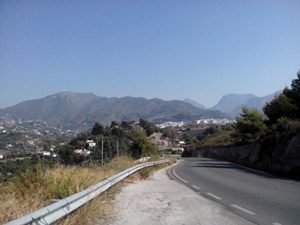
Acebuchal is situated some 7kms from Frigiliana. Acebuchal is an exceptionally beautiful hamlet situated right in the heart of the Sierras of Tejeda, Almijara and Alhama Natural Park. It sits almost on the border between Frigiliana and Competa. If staying in the area you couldn't hope for a better day trip. Spectacular scenery, great food and village that is most definitely "lost" in time. Wandering the streets of Acebuchal and visiting the tiny village chapel really is like going back in time. Mules and donkeys are still the order of the day.
Nature lovers couldn't hope for a better location. The hiking is second to none and the area has an abundance of animals even wild boar.
Acebuchal's history is complicated to say the least. Originally founded in the 17th century, the village sits on a traditional muleteers' route between Granada and Malaga. It has always acted as stop over for passing traders, a place to rest and get supplies.
